Two households fall out. The engine records a grievance, not a mood — it has a cause and a date.
Campaign management for 5e-compatible tabletop RPGs
The world doesn't wait for the party.
Game Master Pro simulates your region's population across centuries — births, trades, apprenticeships, marriages, crimes, curses and the grudges that outlive the people who started them. When the party finally reaches the village, its history is already there.
Nobody is a placeholder
Every person in a scene has an age, a trade, a manner, a want and a family they came from — written by the simulation before you needed them.
The adventure casts itself
An adventure's roles are filled from your own population, so the barkeep is a particular person with a history rather than a line of boxed text.
Run it twice, get two sessions
The same blueprint cast against a different world is a different night at the table. Familiar ground stops being safe ground.
The living world
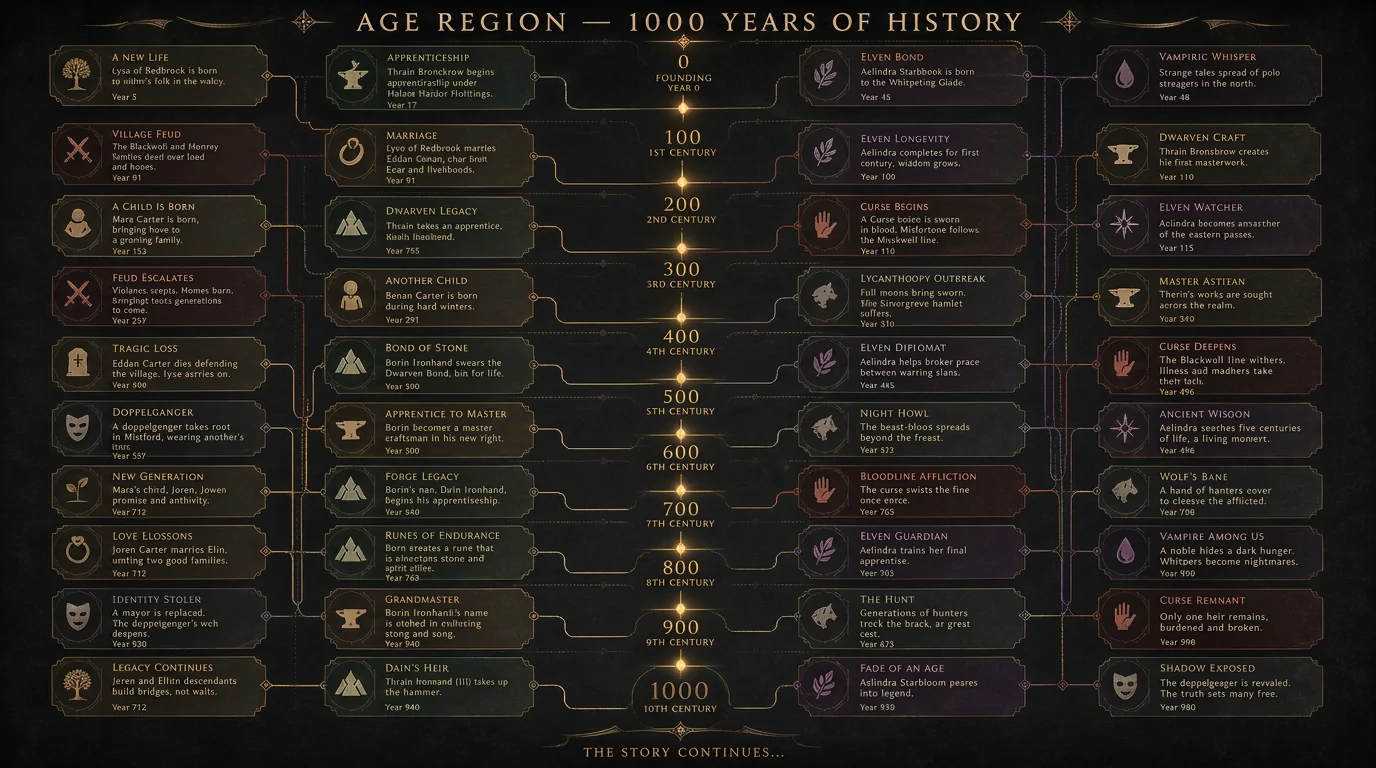
A hundred years happen before session one.
Press Age. NPCs are born, apprenticed, married, ruined and buried. A child takes up a parent's trade — or a master's. Same seed, same century, every time. This is a simulation, not a dice roll.
YEAR 43
A horse is stolen
YEAR 71
The thief's daughter marries
The grievance crosses into a second family. Enmity is inherited at a funeral, not assigned at random.
YEAR 98
A cousin is outlawed
Crime, scandal, injury and curse each run on their own rules and leave their own marks.
YEAR 118
Nobody remembers why
The feud is still carried, and fading, by people who could not tell you what started it. Then your party walks in.
An example run. Feuds, rivalries and enmities are distinct things in the model: a rival is circumstantial, an enemy has a grievance, and a feud is an enmity a child picks up and carries for generations.
Population
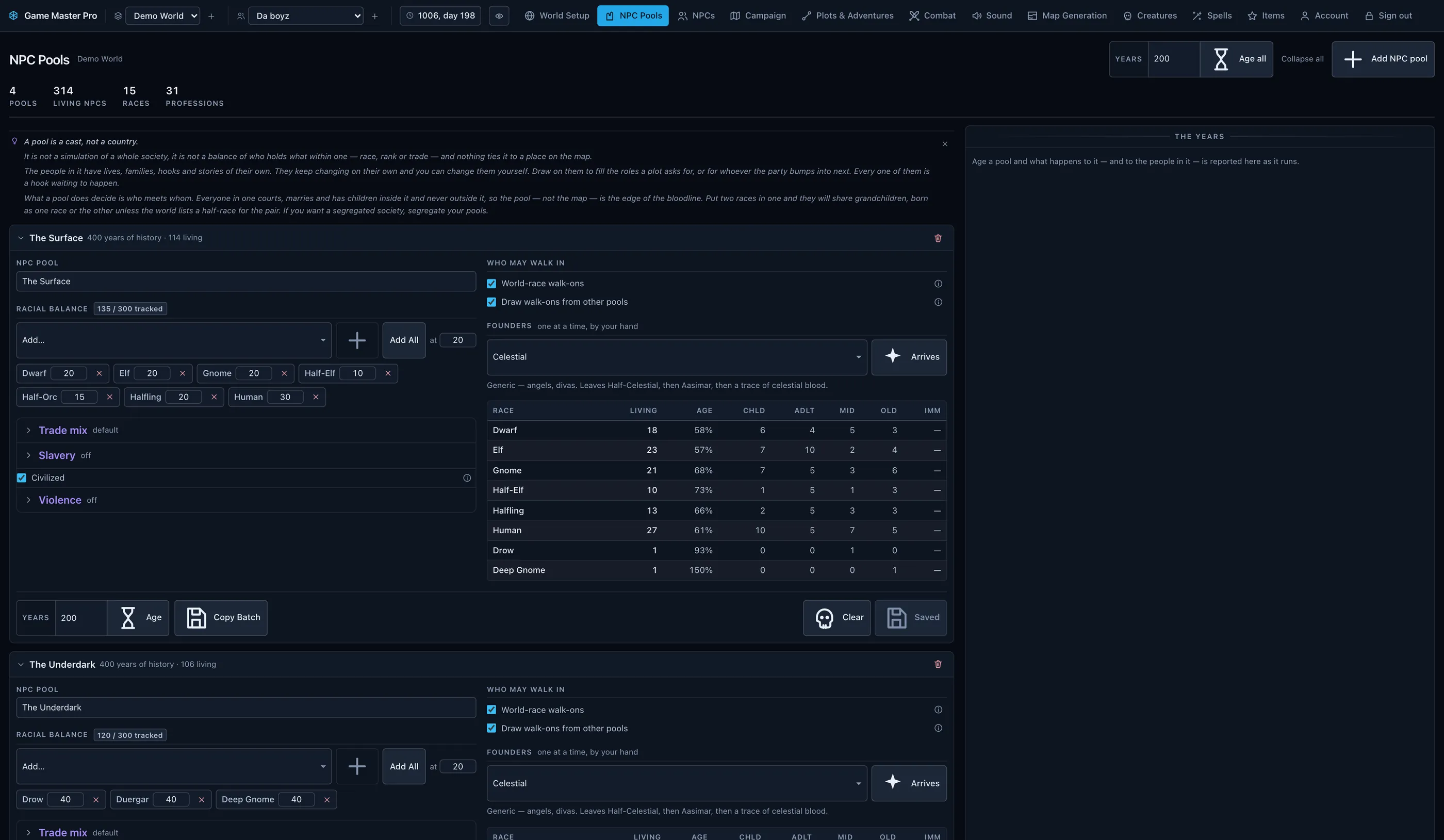
A pool is a cast, not a country.
A pool holds the people your party could plausibly meet — shopkeepers, guards, allies, villains, nemeses — with their own races, trades, ages and families. It is not a census of the world, and it never pretends to be.
They stop aging the moment they matter.
NPCs stay ephemeral until they meet the party or get assigned to a place. Then they are promoted out of the pool and frozen — along with their family — so continuity survives the next thousand-year run.
When a pool runs thin, age it again or seed a fresh generation. The people your table already knows are not touched.
- Royal lines and noble houses shift with births, deaths and scandals.
- Conditions spread — lycanthropy, vampirism, doppelganger infiltration.
- Vampire spawn sometimes rise and destroy their masters.
- Were-creatures sometimes become alphas and gather a pack.
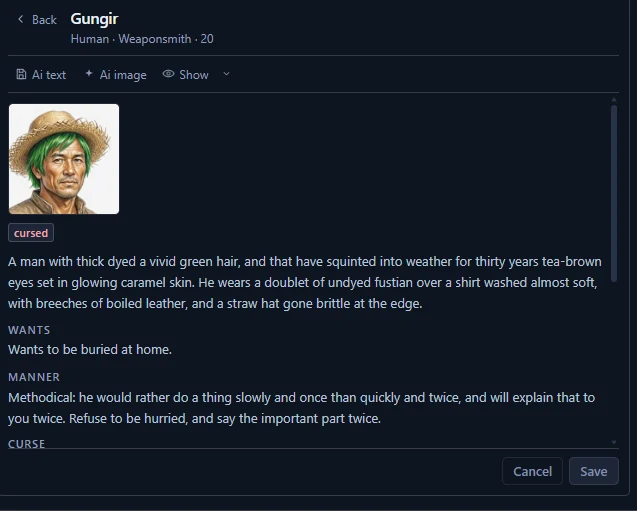
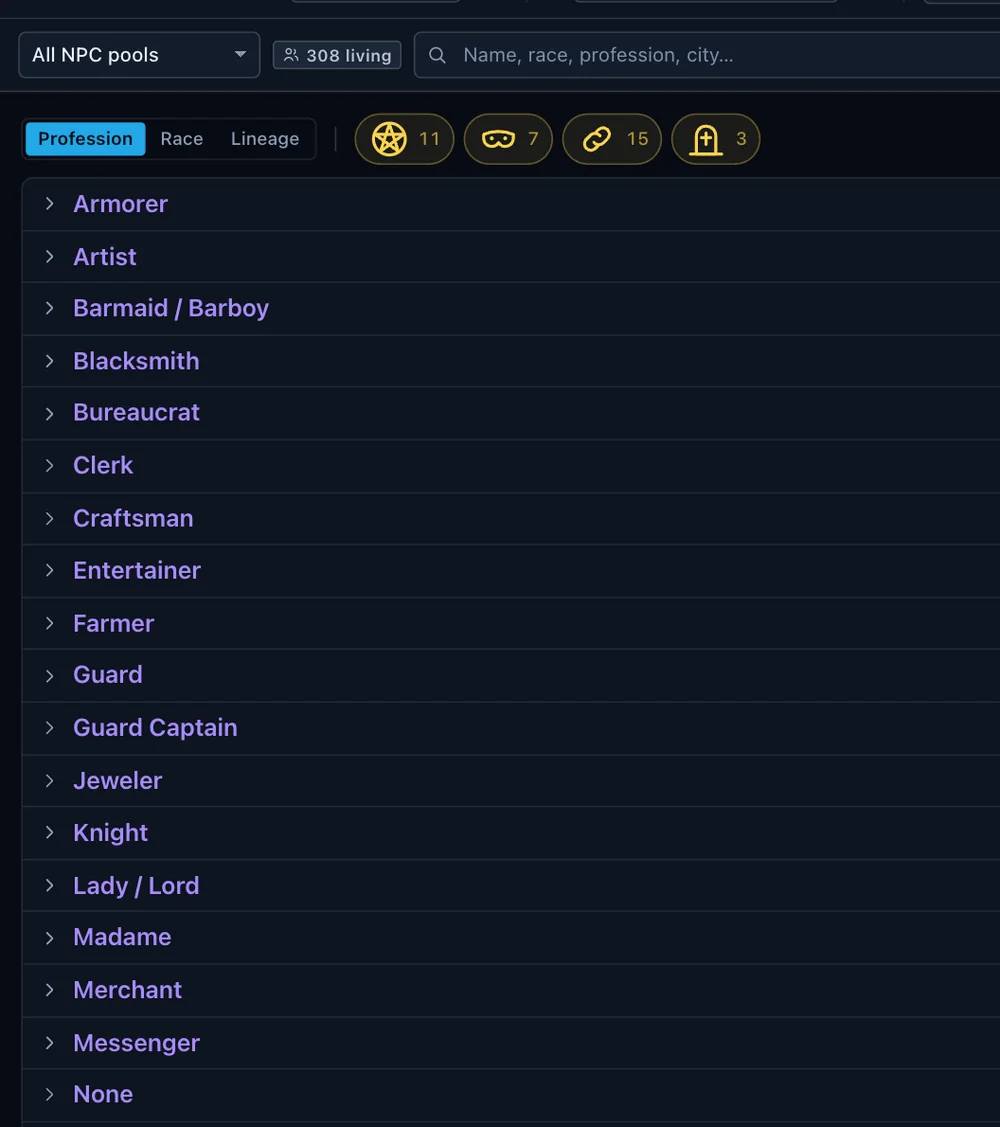
Every one of them is a hook.
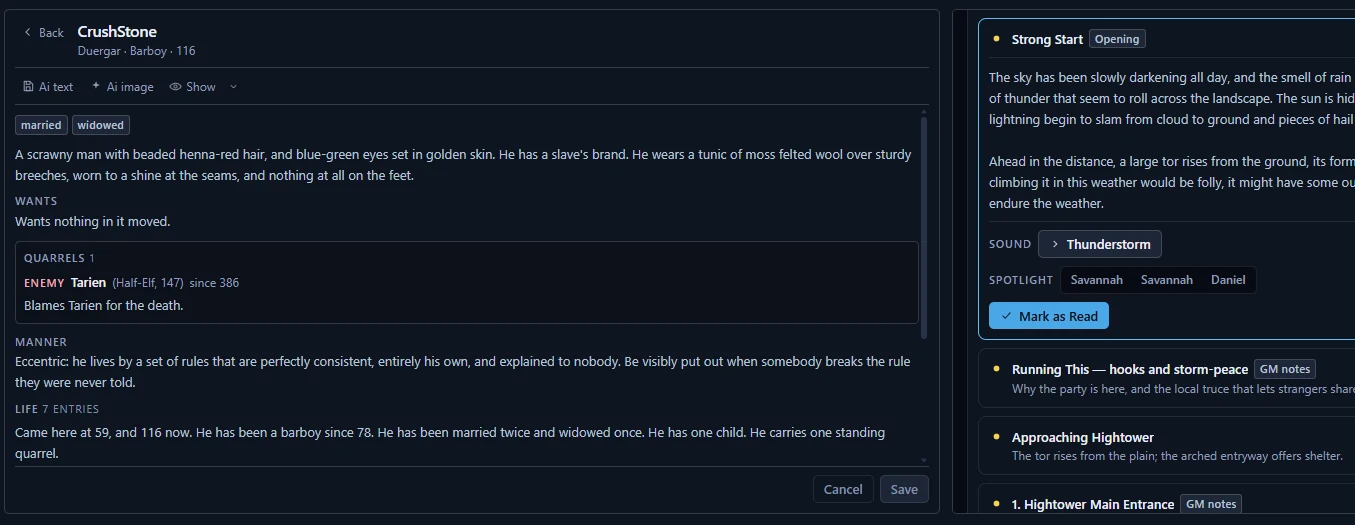
A description written from a curated corpus rather than a mad-lib, a portrait, what they want, how they talk, and the marks the simulation left on them. Gungir is cursed, methodical, and would rather be buried at home — none of which anybody typed.
The map
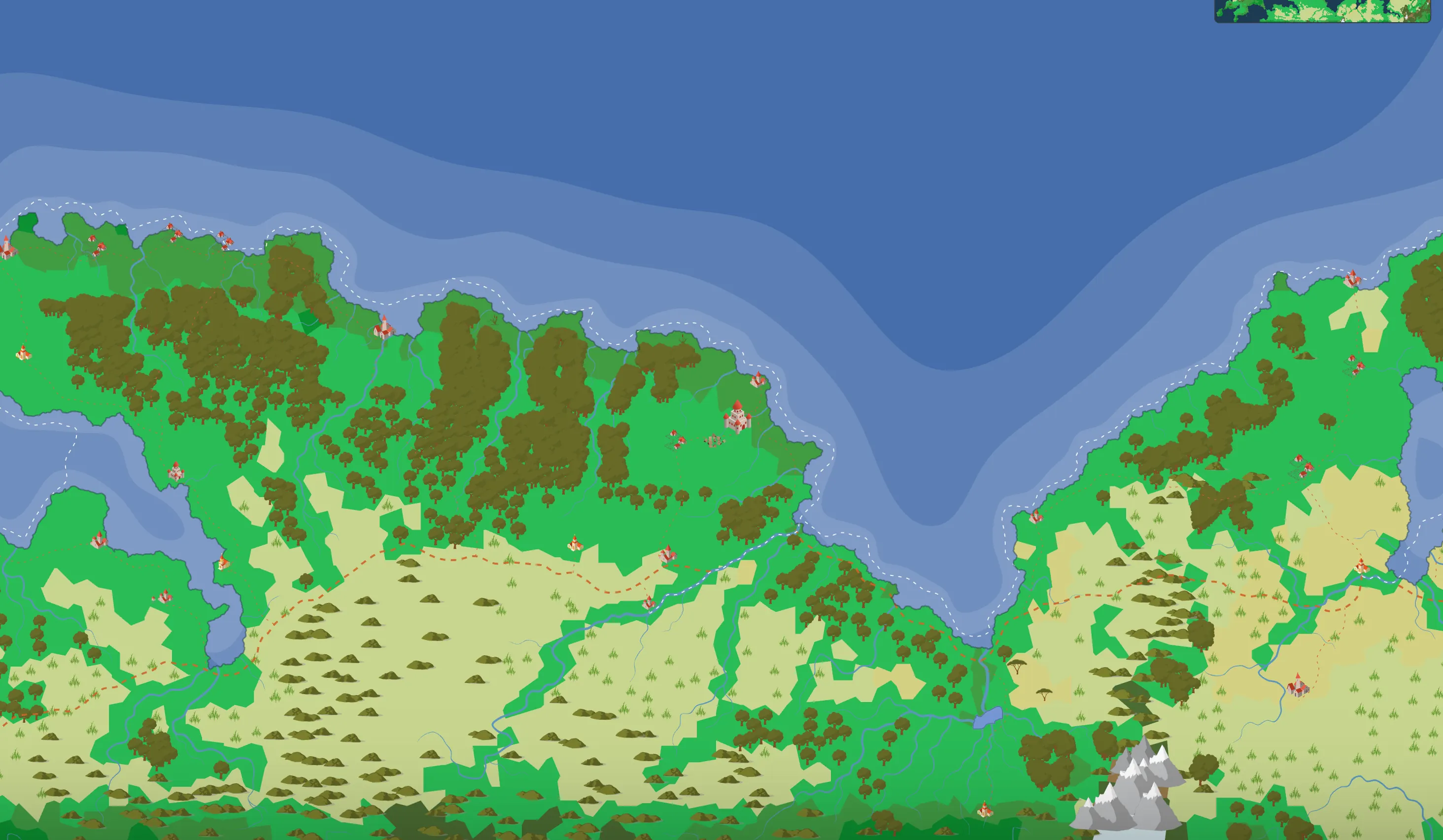
Describe the world. It draws it.
Map Generation is a screen in the app, not a step you do somewhere else and export. Set the era, the scale in real miles, the climate, how much of the land is claimed, how tightly the towns sit, which faiths hold territory — then generate. Or bring a world in from Azgaar's Fantasy Map Generator and it renders that instead.
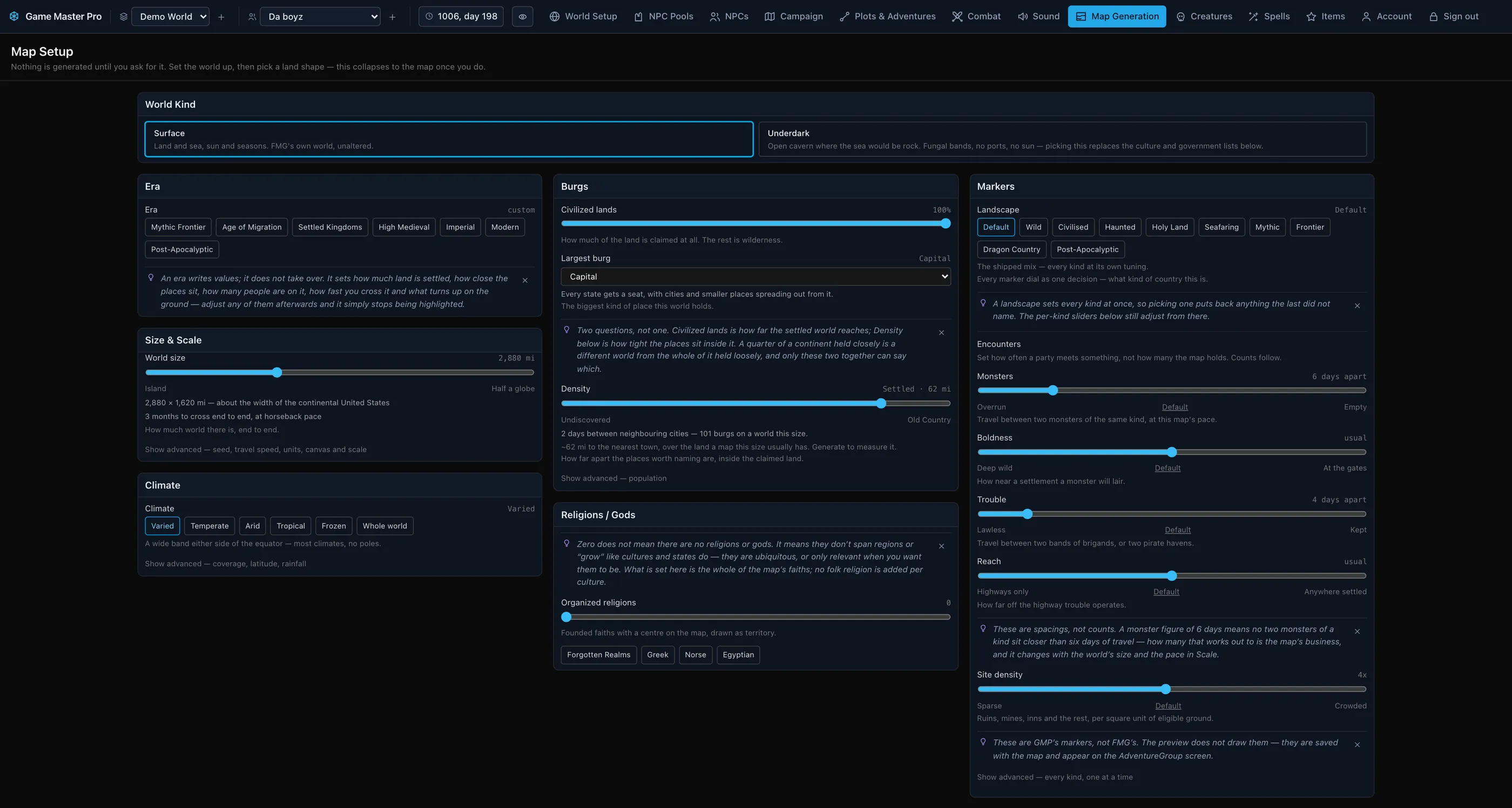
- Distances you can plan against. 2,880 by 1,620 miles is about the width of the continental United States — three months to cross end to end at horseback pace.
- Underdark is a world kind, not a layer. Pick it and the sea becomes rock: open cavern, fungal bands, no ports, no sun, and its own culture and government lists.
- Markers are yours to tune. How bold the monsters are, how near a settlement one will lair, how far off the highway brigands work.
- Or import. A .map file from Azgaar's Fantasy Map Generator comes in whole and renders with its markers.
One world, many tables
Two parties, one region, and no idea about each other.
Run separate campaigns on the same world and watch each group's choices reach the other one. The map, the pools and the people are shared; the fog of war is not.
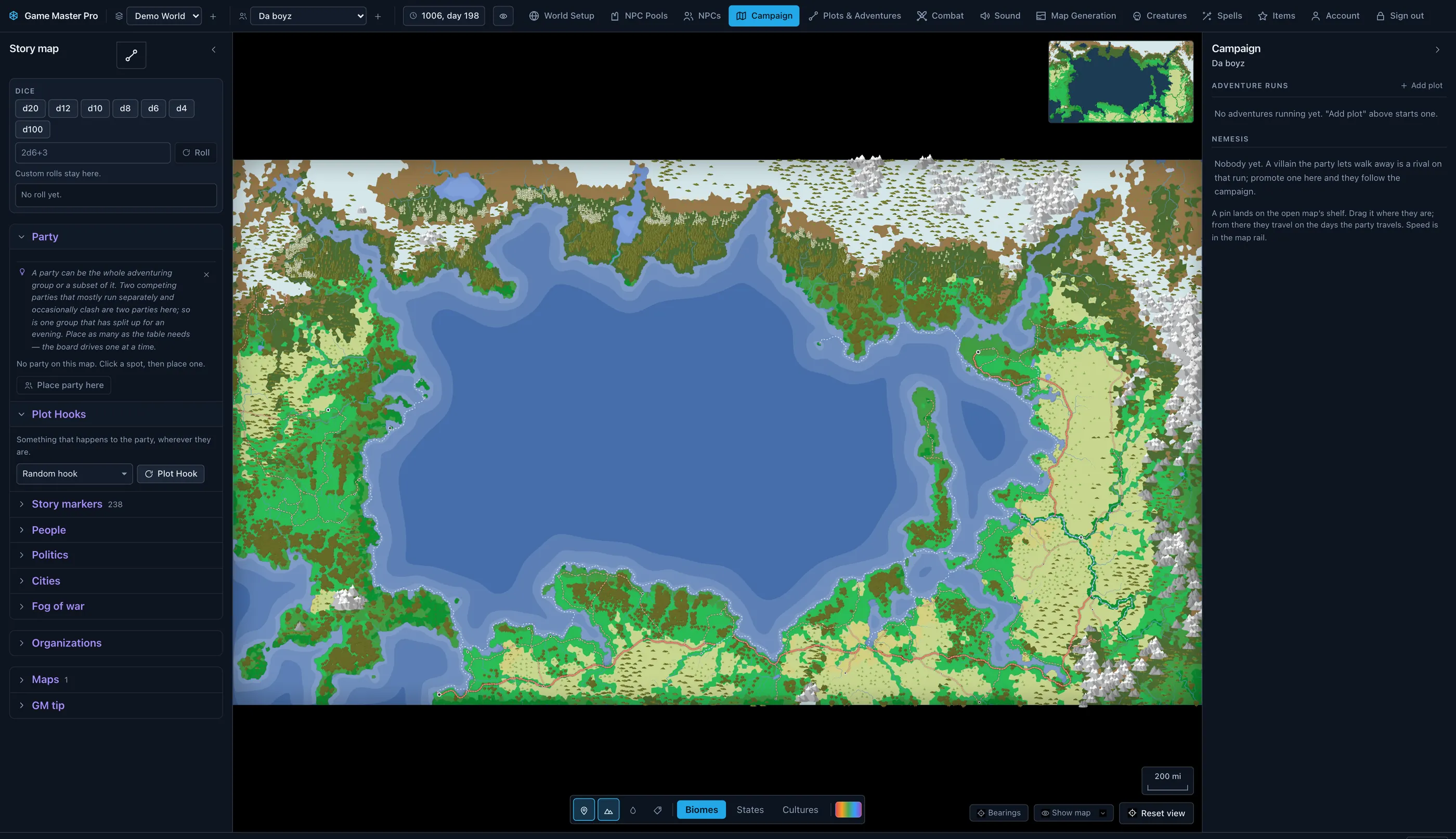
- Competing parties can chase the same artifact, feud over territory, or unleash a curse the other group has to clean up.
- NPCs remember every table. A villain one group spared can become another group's patron — or come for both.
- A villain the party lets walk away is a rival on that run. Promote them and they follow the campaign.
At the table
Everything the session needs, on one screen.
The tool you keep open on a second monitor while you run. No tab hunting, no second speaker app, no initiative tracker on your phone.
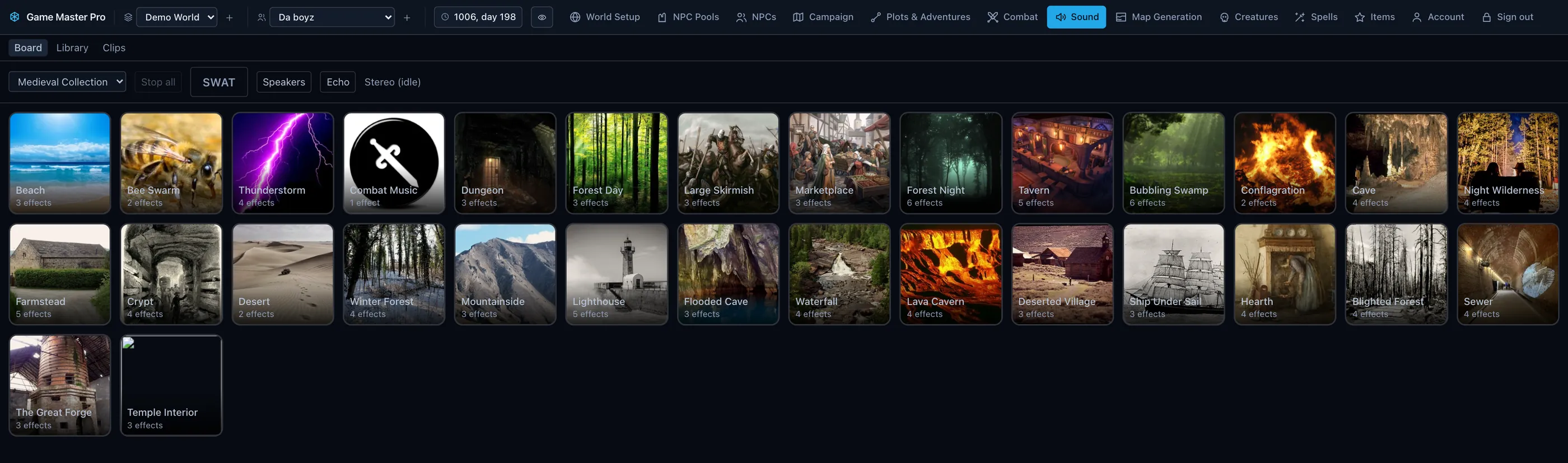
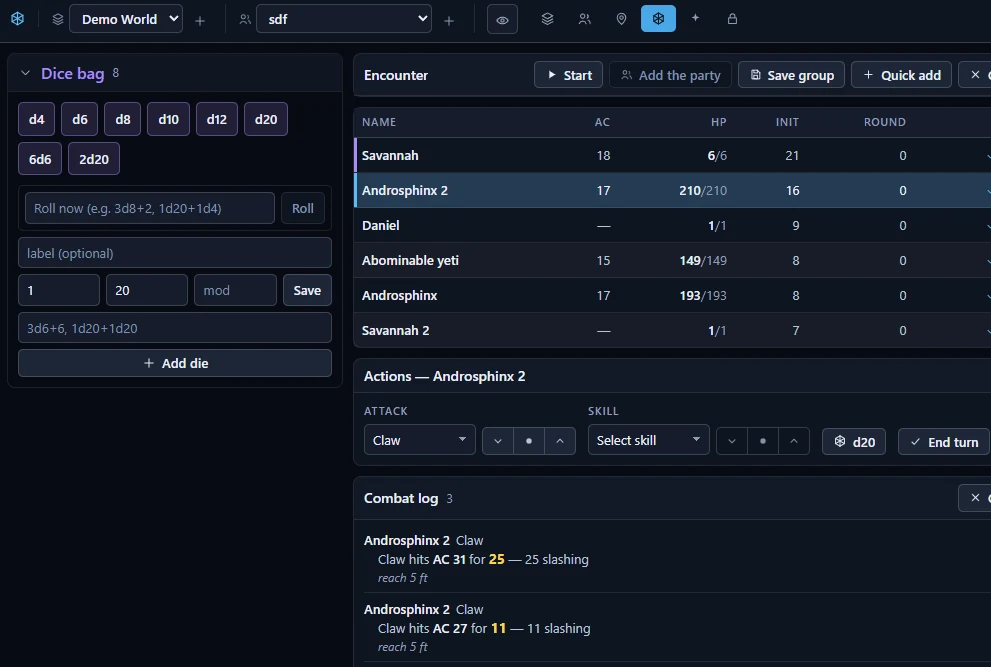
You're the game master. This is the assistant.
Game Master Pro speeds up the bookkeeping and never takes the reins. It rolls, tracks and suggests; you decide which rules matter this evening. Run the whole session from it, or ignore it entirely and just use the simulation between games.
Prep that becomes play
The same adventure, a different session.
An adventure is a blueprint — scenes, secrets, forks, fronts that advance while the party is elsewhere, and a dramatic question. Blueprints are world-agnostic. Casting fills their roles with real people and real places out of your world when a run starts.
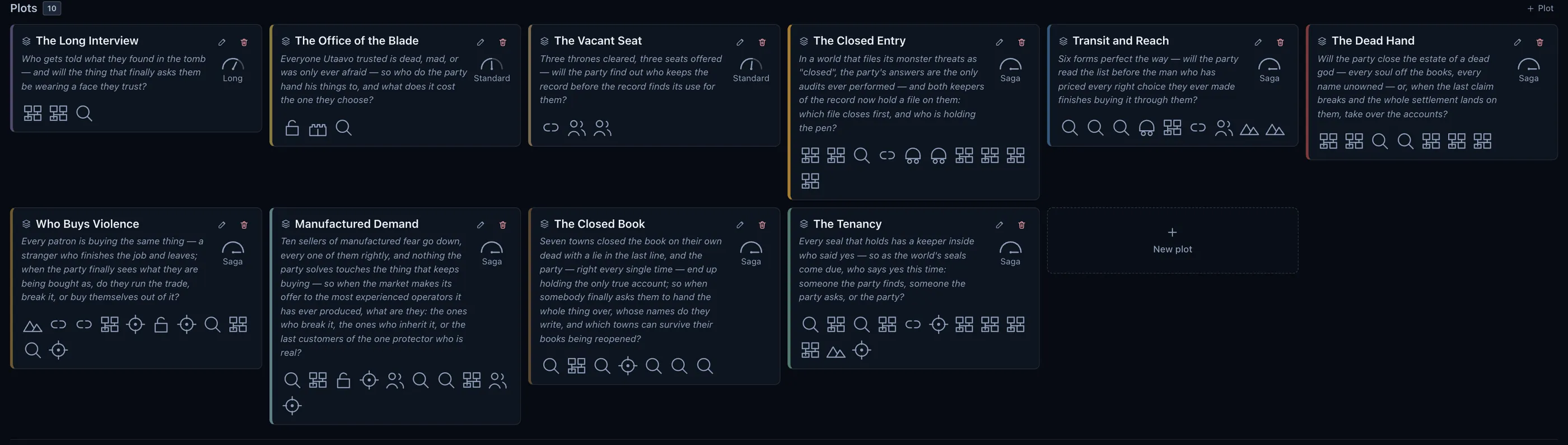
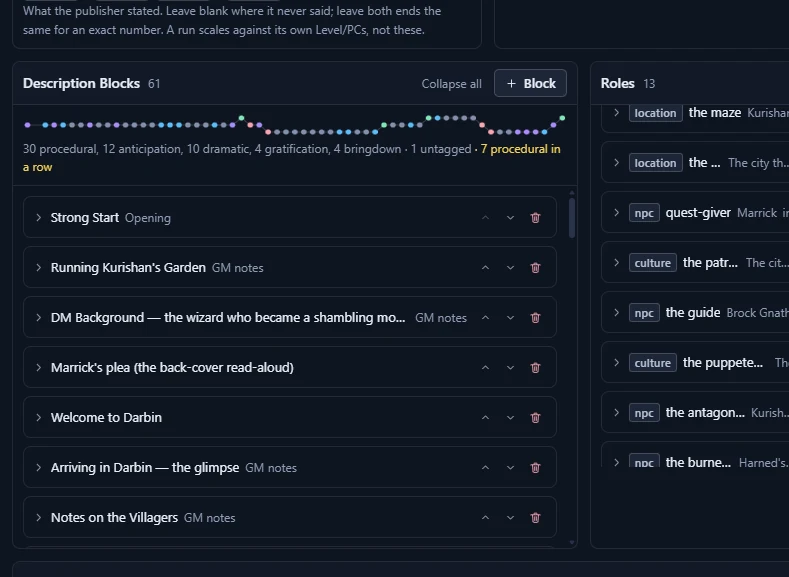
Published adventures gain a new cast every time.
The first time you run it, the barkeep is a tiefling with a sordid past. The next time, a charming human — or a doppelganger. Players learn quickly that familiar ground is not the same as safe ground.
It arrives with 27 adventures and three arcs that weave them together, so the machine is running before you have written anything. After that the shelf grows with you: write your own, or import the adventures you already own.
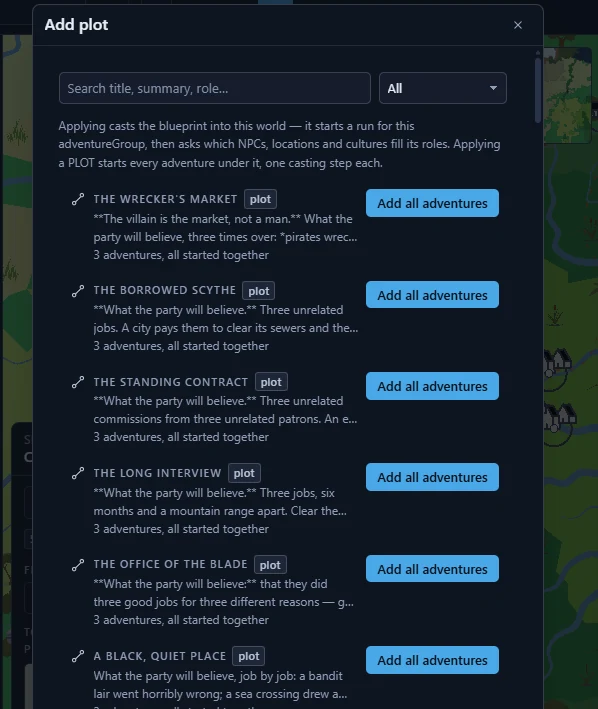
STEP 1
Apply a plot
Pick a plot and a run starts, then asks which NPCs, locations and cultures fill its roles.
STEP 2
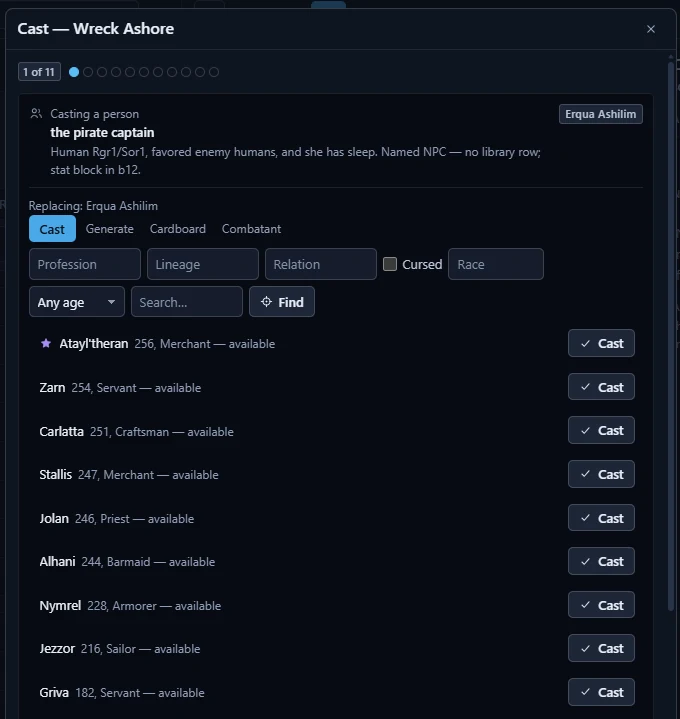
Cast from the population
Roles are filled by people who already live in your world, with their own ages, professions and histories.
STEP 3
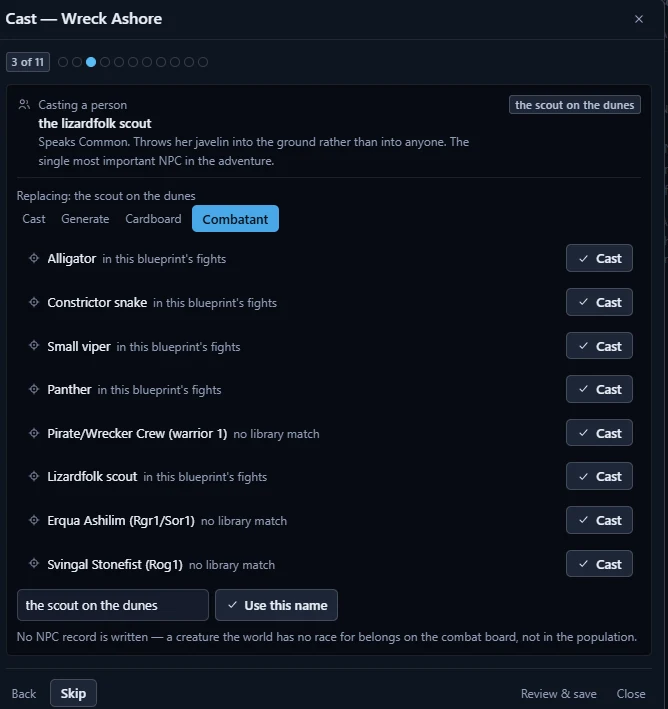
Or cast a combatant
Some roles only need a stat block. Send one straight to the combat board without writing an NPC record.
STEP 4
Run it, and leave it
State is tracked per block, so the board is where you left it when the session picks up next week.
Make it yours
Your rules, on top of ours.
Every library ships with sensible defaults and expects to be overridden. Your edits are a sparse overlay on the shared row, not a fork — fix the base row and your changes survive it.
Overrides that inherit
Change a creature's stats and only the fields you touched are yours. Edit an attack and its attack list becomes yours. Everything else keeps tracking the shared row.
Your world's peoples
Species, professions, descriptives and lineages are set per world, with wealth and magic-item dials the whole world is read against.
Spells and items too
Spells and magic items inherit the same way creatures do. Write your own, or change only what you need.
Your own creatures
Write a stat block from scratch, or fork nothing and just change the one attack that was wrong.

Arms for every house, guild and burg
Generated from 328 charges across 68 shield templates — or built by hand when the house deserves it. They ride along on the map markers.
Honestly
Things this doesn't do.
Cheaper to say now than to find out later.
Not a VTT
No tokens, no grid, no battle maps, no dice roller for your players. If you want a virtual tabletop, keep using the one you have — this sits beside it.
Small shelf
It ships with 27 adventures and three arcs, not a store. Enough to watch the machine run before you have built anything. The rest of the shelf is yours to fill, and adventures you already own can be imported.
Not a writer
It will not write your session for you. There is AI in here — a portrait, a description, a turn of phrase when you ask for one — but it is an assist inside the tool, not the product. The prose that matters is still yours.
Not a rules engine
It will not enforce a ruling for you. Conditions, recharge and initiative are tracked and suggested. Applying them is your call, every time.
Support, not paywall
Free. Genuinely, not as a funnel.
Game Master Pro is fully functional without a subscription. Every campaign, world and combat feature is included, there are no ads, and nothing is gated behind a tier.
If you use it and can afford it, a support subscription helps pay for the hardware it runs on. That is the whole pitch.
Free
$0
everything, forever
Monthly support
$5
per month
Yearly support
$42
per year
The answer to life, the universe, and your campaign.
The current software marketplace would have us believe that the only way to run a business is to offer some of it for free, then paywall the good stuff and overcharge to cover it.
I think if you make a good product and ask for a reasonable fee, people will want to pay for it.
Help prove me right.
FAQ
Which game systems does it support?
The libraries, stat blocks and combat board are built around 5th edition rules. The world simulation, the NPCs, the plots and the sound board are system-agnostic — plenty of it is useful whatever you run.
Do my players need accounts?
No. You send a link — one for the group, or a private one for a single player. There is nothing to sign up for and nothing to install. They can only see what you have put in front of them.
Can I make a world map in it?
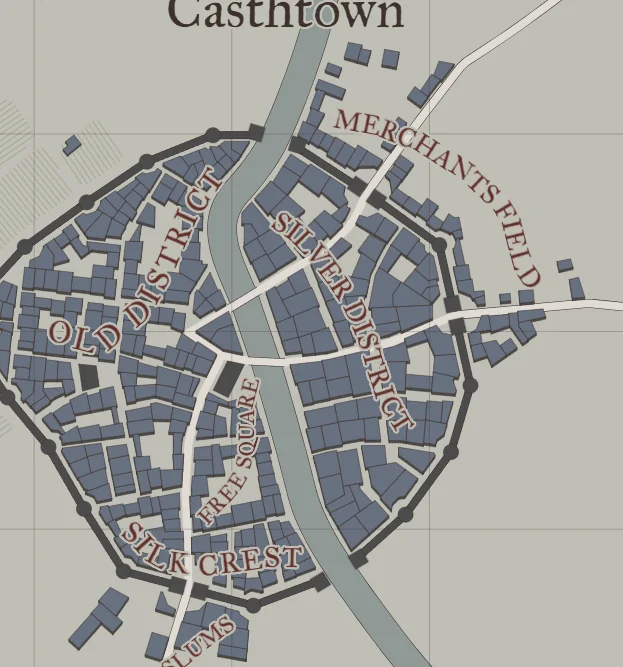
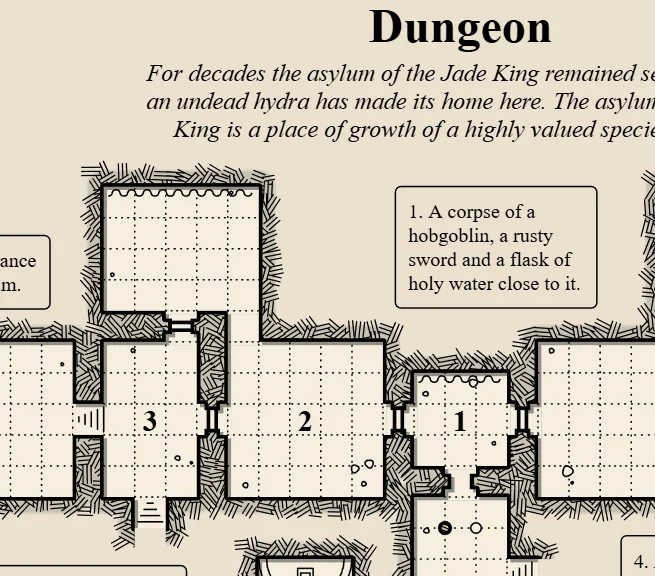
Yes. Map Generation is one of the app's screens: set the era, size, climate, how settled the land is and how thick the trouble lies, and generate. A world built in Azgaar's Fantasy Map Generator can be imported instead, and renders with its markers. Town plans, dungeon floors and cave systems generate on demand.
Does it come with adventures?
One plot, made of three adventures woven into a single arc — enough to see the whole machine work on day one without having to learn it first. Beyond that it is tools, not a shelf: write your own, or import the ones you already own.
Is my world private?
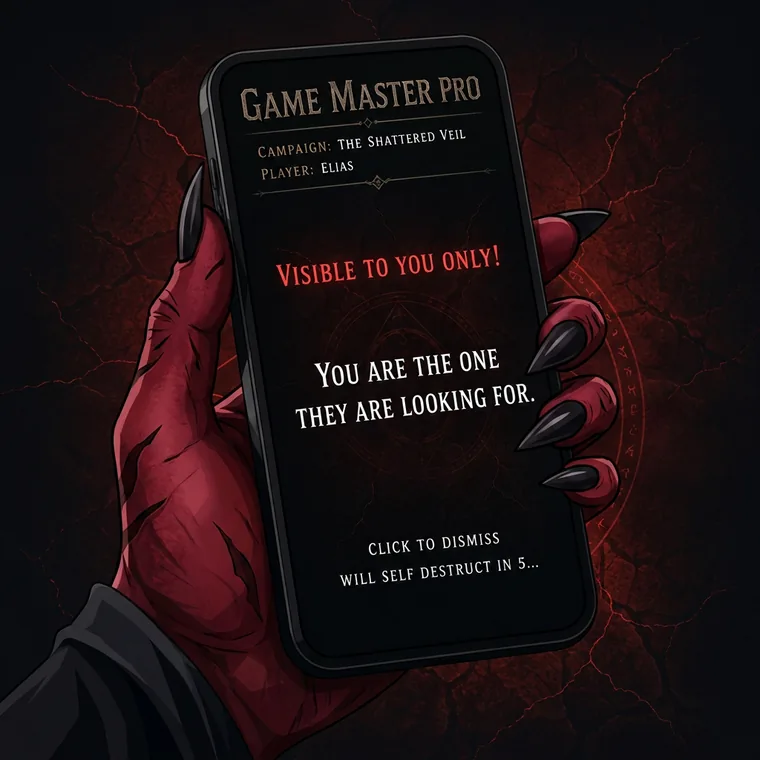
Your world, NPCs and adventures are yours. Player links show only what you choose to reveal, and fog-of-war areas are never sent to a player's device — the map arrives as a picture with the unseen parts simply not drawn.
Is it really free?
Yes. No feature gating, no ads, no premium tier. Support subscriptions are voluntary and go toward keeping the thing running.
Get started
Age a region. See who comes out.
Make a world, set the balance, and run two hundred years before you write a single line of prep.
Already have an account? Sign in.